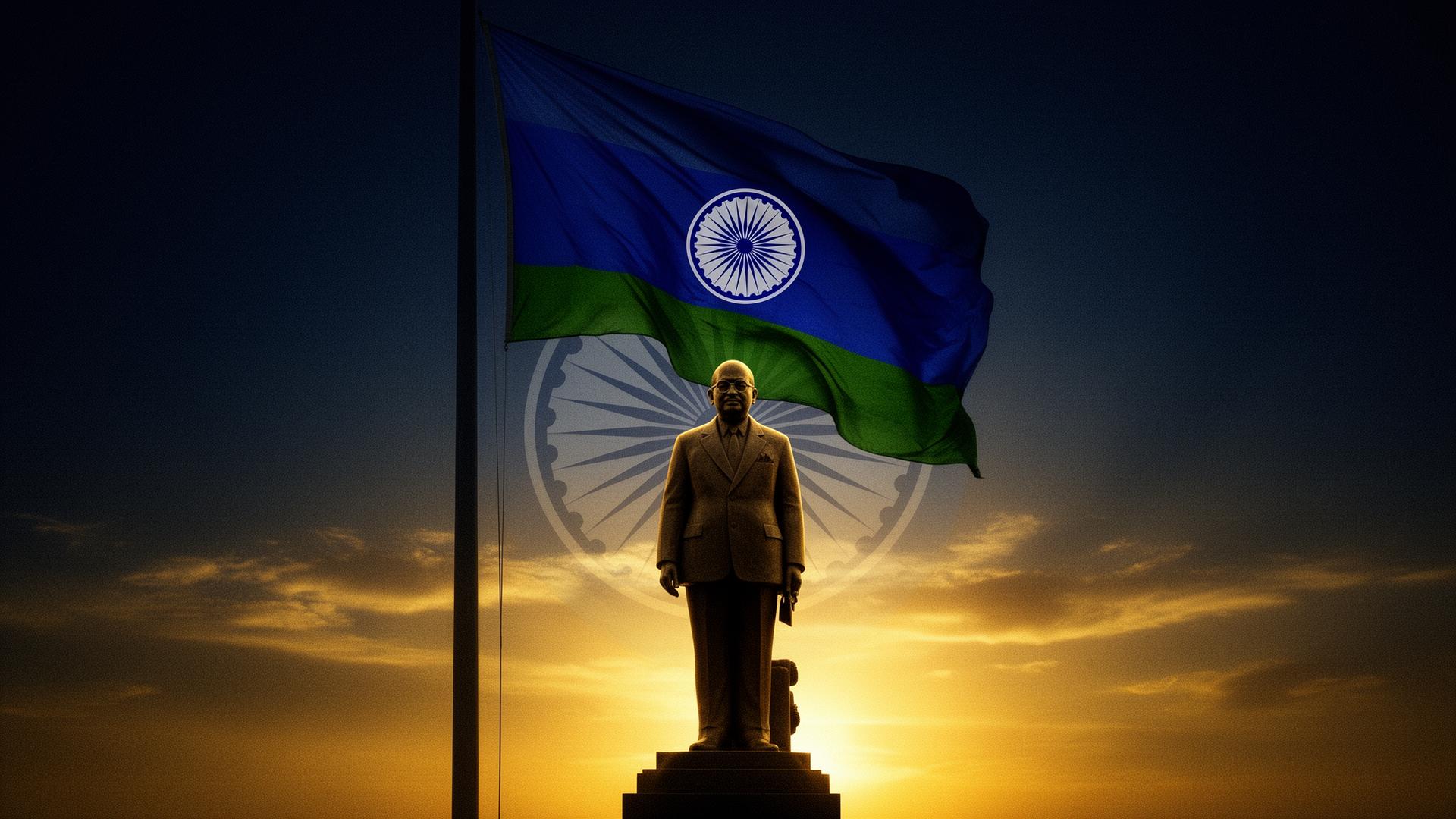
Diya:Why does something so beautiful have to make us so late? What is it for?
Ramcharan:It's Ambedkar Jayanti, madam.
Aditya:Beta, it's the birth anniversary of Dr. Bhimrao Ramji Ambedkar. Born on 14 April 1891, he is regarded as the father of the Indian Constitution. You know he was the one who worked for the upliftment of lower classes who were oppressed for the last 2000 years.
Ramcharan:Yes sir, they are celebrating the birthday of Babasaheb who showed that a person irrespective of their background can stand up for equality.
Diya:Wow, that's amazing!! How did he do that?!?
Ramcharan:He did lots of studying, young miss. Your parents will know the names of the big foreign universities he studied in.
Diya:I remember my teacher telling me about him but she just said that he drafted the constitution, THAT'S IT.
Ramcharan:Oh no miss, before making the backbone of the nation, he uplifted the backward class who were oppressed for two hundred decades.
That's the brilliance of Babasaheb. Savarna, the dominants, did not let him sit on the same bench or share the same water tube, but he rose against casteism, fought the oppressors and then became a highly educated jurist who drafted the law book for the WHOLE nation — The Constitution of India. And not just that miss, he also served as India's first Law Minister, fighting for equality from within the very system that once tried to keep him out.
Aditya:Dear, you must have heard stories and legends of kings who fought for their life. But here's the live example of the man who fought for his society, his community, who challenged the destinies of his life.
The boy who once was deprived of water, became the reason for trillions of households and millions of women to get a dignified living.
Diya:Oh wow dad!! Tell me his story please!
Aditya:Okay beta, I'll narrate a short story to you:
Bheem Rao Sakpal, for that was the name of the man, when he was born. He was naturally inclined towards studies, but being untouchable, he was denied one. His mother passed away when he was very young, and his father raised him as best he could. He was the youngest of the siblings. So naturally, he was also the one who suffered the most.
Even for drinking water, he had to ask the peon and on days when there was no help, he spent his day without having a sip of water.
Later, because of his dedication when the upper class was against him he would finally go for higher schooling, and that's when Bhimrao Ramji Sakpal became Bhimrao Ramji Ambedkar!
Diya:But why did they not let him use the water and all?
Ramcharan:See, he was from the Mahar community. Mahars are considered impure and untouchable according to Hindu caste hierarchy. You know, I belong to such an impure community myself, yet I am driving the same car you are sitting in without polluting it. Babasaheb made people understand that we are not impure, we too are made of the same flesh and bones like the upper caste Savarnas, our genes don't make us some demons that you can't touch.
Diya:Of course you all are not different, that is such a wrong mindset.
You know, my teacher told me that he took his teacher's surname. Is this true papa?
Aditya:Yes, you're right beta. Teachers shape the personality of the youth, and youth shape the personality of the nation.
Do you know when he passed his English exam, a public procession was called by the community to celebrate the achievement. See, that was such a big feat for them. Because of the discrimination and hierarchy they faced.
Ramcharan:No sir, not because of poverty. They took pride because they showed them that they can be as educated as any of them if given the equal opportunity!!
Aditya:Haha! You got me again Ramcharan.
Diya:Absolutely! My teacher says that WITH EDUCATION, ONE CAN ACHIEVE ANYTHING!
Ramcharan:Babasaheb was highly educated, you know. He pursued higher studies... that too from big big institutes from London and America.
Aditya:Beta, in 1907, he passed his matriculation and he got into Elphinstone College, which was affiliated with the University of Bombay. In 1912, he got a degree from the Bombay University and started preparing for the Baroda State Scholarship. At the age of 22, that is in 1913, he was awarded the scholarship which got him into Columbia University in New York City. And in 1915, he passed his MA examination, majoring in Economics. Also, in 1916, at the time of the World War, he enrolled himself in a Bar Course at the Gray's Inn and at the same time, he also got enrolled at London School of Economics. But due to circumstances and the end of his scholarship in 1917, he had to return to India.
Diya:That's surprising, how was he able to go? Cause as you shared discrimination was at its peak and he was also suffering from poverty.
Aditya:He got a scholarship from the Maharaja of Baroda on the condition that he had to come back and take part in the Baroda civil service. In 1917 he returned and after 3 to 4 years he went back and completed his studies with the help from his friends.
Do you know, when he was getting back in 1917, there was another German vessel which was carrying his thesis, but it was targeted and it sank. But he was not lost. He was determined and at that time, he was granted a four-year period, and in 1921, he presented his thesis and was awarded his Master's degree. Now that was the dedication of B. R. Ambedkar, a man who carved his own destiny.
Diya:Oh wow papa!!!
Aditya:Situations came, and situations went, but the man stood firm. Why? Because he was not fighting for himself alone. He was fighting for his community, for his society, for his nation.
There are times when you feel like you are failing in life. But in those moments, you must remember there once stood a man like Bhimrao Ambedkar. A man who not only thought, but taught us that life will test you, again and again.
And when those moments come, that is when you must stand upright shoulder to shoulder with your struggles, look life straight in the eye and say:
"I can do it."
Aditya:And beta, his fight did not stop at education. In 1927, he led the Mahad Satyagraha, where he marched with thousands of Dalits to drink water from a public tank that was denied to them. It was one of the first great civil rights marches of India. And then, after independence, he became India's first Law Minister, and it was he who chaired the drafting committee of our Constitution giving every citizen of this nation, regardless of caste, creed or gender, equal rights under the law. And in 1956, realizing that the caste system was deeply rooted in religion, he converted to Buddhism along with thousands of his followers, seeking a path of dignity and equality.
Ramcharan:Oh wow sir, that is so inspiring!!
Sir, I believe Babasaheb became the shield of the Dalits because of his foreign exposure, where he noticed there was no caste system. Even today sir, I drive people who have never left the city and stayed in their own conservative bubble, and I have noticed them being uncomfortable around me because of my surname... and I drive people like you who are educated and have been exposed to other cultures who have developed the mind of humanity... I think everyone should face cultural exposure sir.
Diya:What happened when he came back after studying so much?
Ramcharan:He faced tremendous discrimination. Not due to bad management of his own work, but due to the mindset of people around him. Lower ranking officers would throw files at him instead of handing them over, they would not share his water... you know what miss, he was not given a house. He and his elder brother traveled from one hotel to another, but no one was willing to accommodate them due to their caste. Eventually, he secured lodging in a Parsi inn by concealing his identity; however, when his true identity was discovered, his belongings were thrown out.
You see, education broadened his intellectual horizons; however, his knowledge and abilities did not shield him from discrimination. Even today, there persists a tendency among some individuals to associate caste with intellectual inferiority.
Aditya:Many individuals may have personally experienced such situations. While societal attitudes play a significant role, political narratives have also contributed to deepening divisions. Certain political approaches, driven by electoral considerations, have at times reinforced feelings of enmity and polarization.
The vision that B. R. Ambedkar had for reservations—as a means of uplifting historically marginalized communities—continues to be debated in the 21st century. Although reservations have enabled sections of these communities to access opportunities, social perceptions have not evolved at the same pace.
Even when individuals from marginalized backgrounds attain positions of stability and success, they may still face exclusion or skepticism, often being told—implicitly or explicitly—that they do not belong, with their achievements attributed solely to reservation policies.
This disconnect reflects a broader challenge: while structural measures have facilitated progress, deeply embedded social attitudes and political rhetoric have, at times, limited the realization of Ambedkar's vision of equality and dignity.
Diya:But papa, Babasaheb himself was a politician and he fought against the Varna system!
Aditya:You are right, and that is precisely what distinguishes him from many others. B. R. Ambedkar was not opposed to the idea of social organization itself; rather, he strongly opposed a system in which social status is determined by birth. In his writings, he emphasized that any form of social classification, if it exists, should be based on individual merit, conduct, and ethical values rather than inherited identity.
According to this perspective, a person's position in society should be defined by their abilities and character, not by lineage. This reflects his broader vision of a society grounded in equality, dignity, and justice.
And see, this is the 21st century. We are sitting in a car, and all we can see are people doing processions. It is good, but look at all those cars that are still honking because they don't acknowledge the fact that a man can gain such popularity because of his own merit and not because of his caste and everything.
(Just then, the traffic began to clear. The car slowly moved forward.)
Diya:(looking out the window at the procession) Papa… I want to be like Babasaheb someday.
Aditya:(smiling) Then remember beta — educate yourself. That was his first and greatest weapon.
Ramcharan:(softly, eyes on the road ahead) And his last gift to all of us.
(The car moved forward, as the procession continued, colorful, loud, and full of life. Just like the man they celebrated.)